One of the key talking points in the lead up to the World Cup in USA, Canada and Mexico is what weather conditions matches will be played in.
Researchers have warned that 14 of the 16 venues throughout the tournament will reach dangerous conditions, one of which will be England's base in Kansas City.
According to new research by Climate Central, who examined the odds of temperatures exceeding 28C - a threshold linked to declines in player performance - 97 of the 104 matches face a higher probability of encountering performance-impairing conditions.
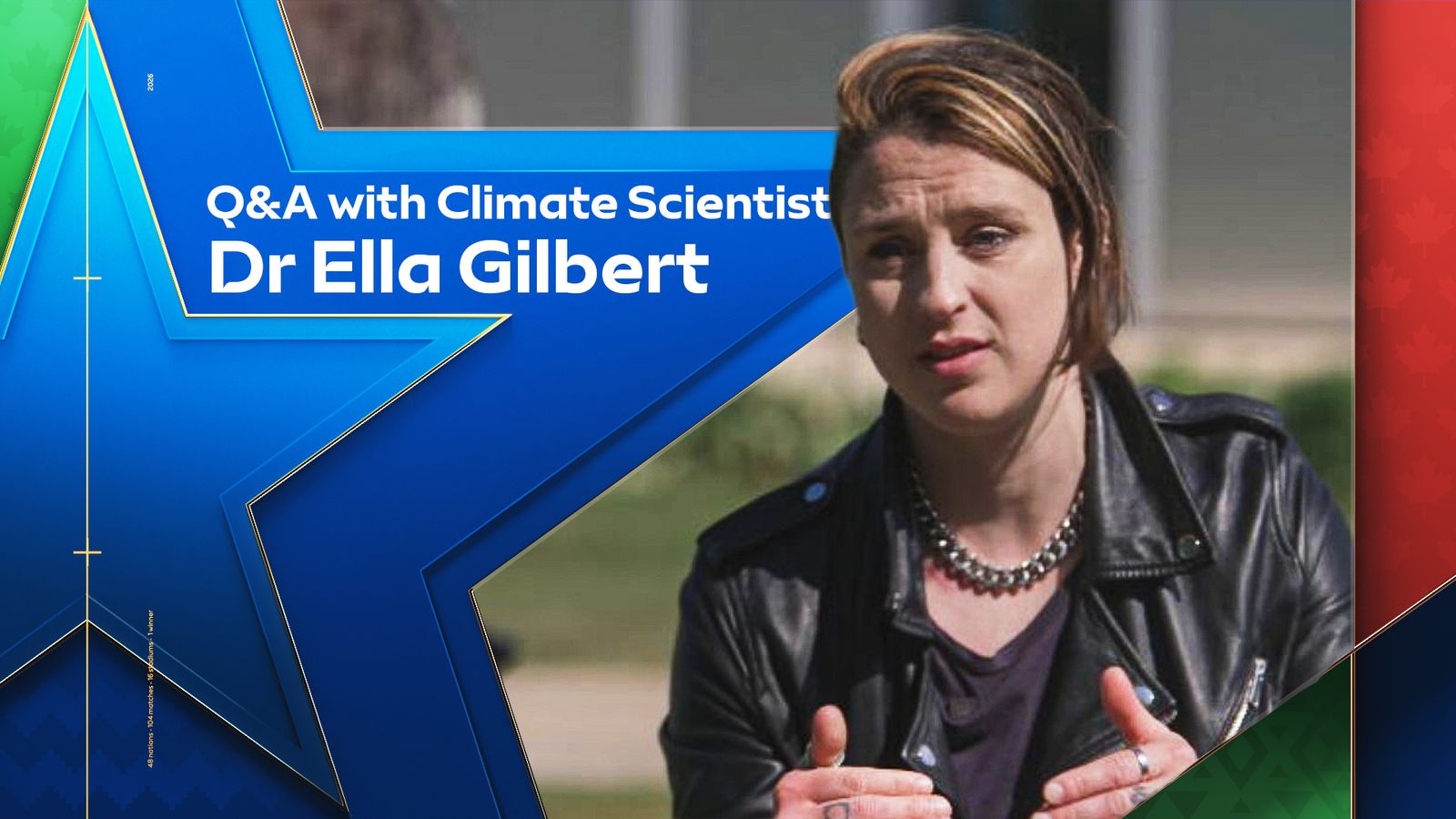
To get a grip of the seriousness of the situation - and what the future might hold - Your Site News' David Garrido invited climate scientist Dr Ella Gilbert down to Sky Studios...
"It was a really hot year in 1994. It was a couple years after a volcanic eruption which caused temperatures to drop. In '94, temperatures were rebounding and there was a mega heatwave in the US and the southern part of Canada.
"Temperatures in June and July were climbing to the 40s and even topped up at around 53C in parts. It wasn't raining very much, which wasn't usual for the 90s.
"Since then, global average temperatures have kept rising. We still have heatwaves and we see them more often. When we do see them, they are much hotter and last longer.
"In 1994 it was around 0.55C above pre-industrial temperatures. Now, we are about 1.55C above. That has brought more extreme events and pushed average temperatures of heat waves upwards. It is making extreme events, like floods, droughts and storms, happen more frequently."
"One degree doesn't sound like very much but, actually, the difference is sizeable. It took 140 years for the climate to warm by about half-a-degree compared to the pre-industrial period where we hadn't done any climate warming.
"In the 30 or so years since the 1990s, we've done the same again plus some. Heating has accelerated in the last 30 years and it's only ramping up and having a significant impact.
"It is a fundamentally different climate. We are pushing the envelope of what is considered normal and we are making extremes more extreme: heatwaves are hotter, droughts are lasting longer, floods are bigger, rainfall is more extreme.
"It's having an impact on every corner of the globe and all of us are experiencing the effects."
"It will depend on the conditions on the day, but we should never underestimate the impact on people of extreme heat and other types of extreme weather.
"We are more likely to see hot conditions and because of every degree of warming, we get more humidity, so it will be less comfortable to be a player in those conditions. It is more humid and hotter.
"We are more likely to see players stopping to get hydrated or getting rained off by some intense downpour which appears out of nowhere.
"These interruptions are more likely and the strategy or tactics to manage player health is going to have to adapt.
"Both teams experience the same conditions so in that sense it is fair, but, inevitably, it is going to change the game. We should all bear that in mind when we are watching."
"In certain parts of the US, you get a lot of rain anyway, but with every degree of heating in the climate, we get seven per cent more moisture in the atmosphere. That means you are more likely to see those torrential downpours.
"It can, of course, cause play to get called off and I am sure we will see one or two this summer."
"It is a weather pattern that emerges every five to seven years. It starts in the Pacific Ocean and is about the warmth of the surface of the ocean. Sometimes it is cooler and sometimes it is warmer.
"When it is warmer, it is called El Niño and it can have global implications. Generally, it leads to warmer temperatures over the planet as a whole but has different impacts in different places.
"In the northern part of the US and southern Canada, it is warmer and drier. In the southern parts of the US, it tends to be wetter and cooler. It is also rainier on the west coast as it causes the jet stream to shift.
"If we focus on the World Cup, we will see the impacts depending on where the games are played. You are more likely to see rainy conditions on the west coast and drier conditions in the northern parts of the US or southern parts of Canada.
"There was an El Niño in 1994 and temperatures were really high. The last time we had one was 2023 to 2024, which were the hottest years on record."
"It all depends on how you cope with the situation, how you deal with those conditions.
"Part of the picture is that, of course, those conditions are becoming more extreme, more hostile and more difficult to manage. Some countries are going to be better equipped to adapt to that and, if they can build air-conditioned stadiums, that's already one important adaptation.
"But when the cost of that - both financial and otherwise - outweighs the benefit of hosting a World Cup in that country, you have to reassess the trade-offs.
"We might have to do what they did in Qatar, where we might have to change when we have the games.
"Climate change is already impacting every single of society and it's only going to continue to do that and makes its effects even more known. Sport is just one of the many parts of society that is going to have to adapt."
"Around that time is when we really start to see the impact of our actions today. The futures really start to diverge in 2050, 2060. If we decide now to reduce emissions and try to limit the amount of heating we, ultimately, end up with, then we will start to see that kick in around then.
"On the flip side, if we don't do anything and we continue as we are, burning fossil fuels, deforesting, then we will see the impact of that translated. That's going to completely change the landscape. We'll start to see hotter temperatures then if we choose emit lots of emissions now.
"Inevitably, we're going to see hotter conditions because we are still going to continue heating the planet, but it's in our power to decide how much heating we see by that point.
"The World Cup we see by 2050 or 2060 will be hotter. It may be moisters, more humid, less tolerable for the players, fans and officials and it will be more extreme, so we will see more extreme events.
"Everything we've been saying now versus 1994 will be the same, but amplified."
You can follow the 2026 World Cup on Your Site' platforms, with live blog coverage of every single game of the 104 matches, from the opener on Thursday June 11 to the final on Sunday July 19.