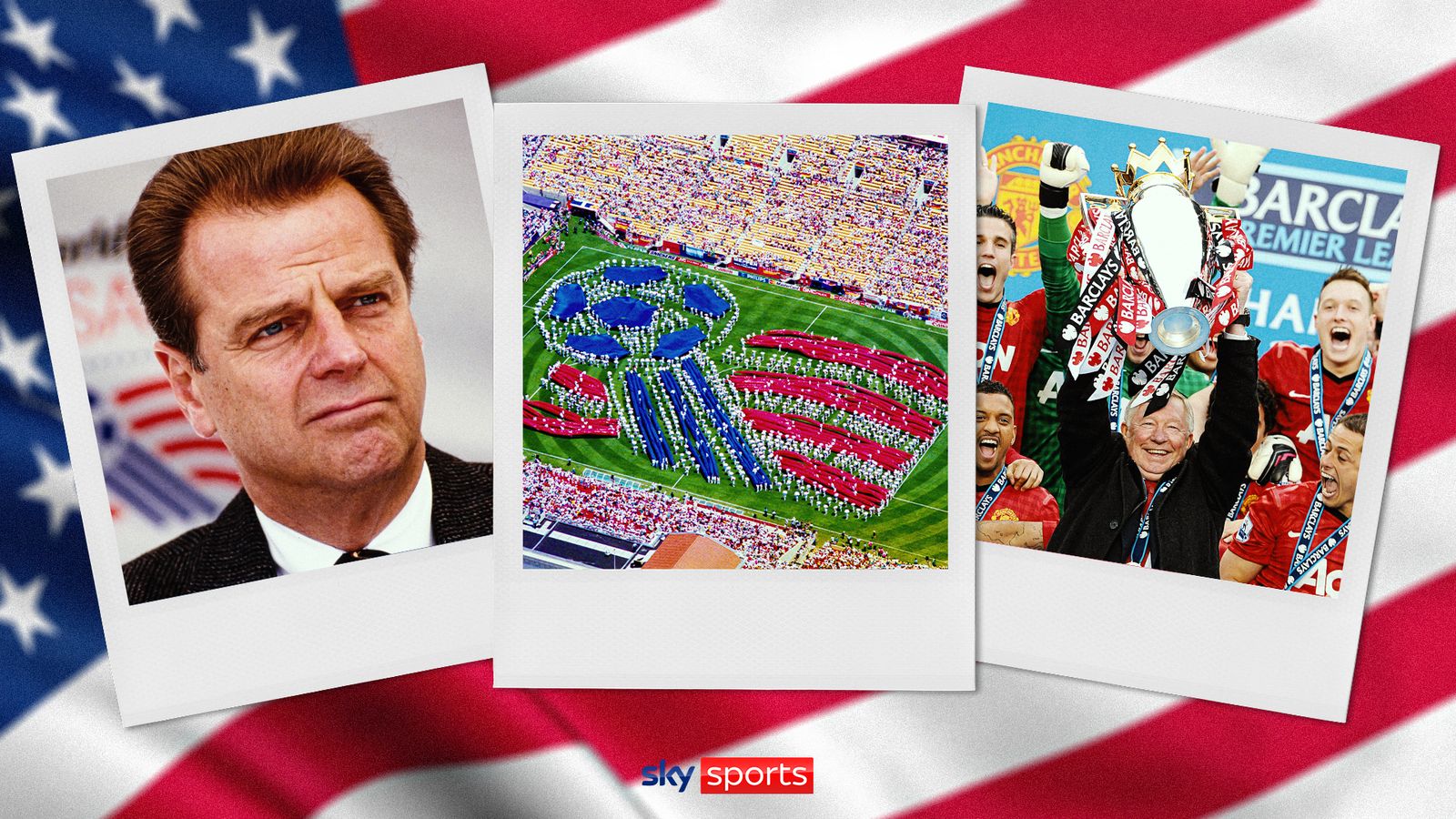
Alan Rothenberg had a vision: A World Cup so enticing it could convince the USA - and the world - that the country could fall in love with football.
A vision to use the greatest sporting show on earth to win over a culture which had never shied away from the spotlight, but had never taken to the beautiful game.
A vision which was certainly bold for a man sat in a portable cabin in Colorado Springs alongside all six of his full-time staff.
It was the summer of 1990 and Rothenberg had just been elected chief of the US Soccer Federation (USSF) - the highest position in US football, but with precious little infrastructure for a country which had a World Cup to host in four years' time. "The federation was not professionally managed; it was essentially a volunteer organisation," he recalls to Your Site.
More than three decades later, football has overtaken baseball for the first time to become the USA's third-most loved sport according to a recent survey by The Economist. There are many reasons for that beyond the 1994 World Cup he organised, but the tournament and its legacy undoubtedly got the ball rolling.
But back then, Rothenberg's aspiration seemed pure fantasy. The US had beaten Brazil and Morocco to host the tournament but FIFA's decision had been derided given the country's wider apathy towards football. "Taking the World Cup to the United States is like taking the World Series to Brazil," snapped one jilted Brazilian FIFA delegate.
Winning over the public was not Rothenberg's only problem. The American domestic game was in tatters, without a top-flight league for half a decade since the demise of the NASL - once home to Pele, Eusebio and George Best before a long struggle with dwindling interest.
The US national team was barely in better shape and had missed out on nine of the previous 10 World Cups, and with qualification guaranteed in 1994 required major surgery to live up to the hopes of an expectant home crowd.
Relations with FIFA had also become strained after a botched application to step in and host the 1986 finals when Colombia withdrew. But the world governing body's support for Rothenberg - a new face in football but with significant sporting experience - played a major part in him defeating old-guard incumbent Werner Fricker to lead the USSF and its World Cup task force.
"They were having difficulty getting the World Cup preparations off the ground, so FIFA asked me to run so I could step in and take over," says Rothenberg whose new book, The Big Bounce, details his involvement in the growth of US football in the 1990s.
"I'd been fortunate enough to be deeply involved in the 1984 Olympics in Los Angeles. It was clear to me from those Games, and other sporting tournaments, that Americans love a big event.
"My vision, if you will, all surrounded that. The inspiration was to convince the American public that this was an event they couldn't miss.
"And if we do that, we'll be successful in creating a lot of enthusiasm and, ultimately, big attendances and large revenues.
"So we really embarked on a non-stop effort to promote the World Cup as a big event."
The reality was, of course, more complicated than the idea. The US was well-equipped logistically with large stadia and existing transport links which had underpinned its winning bid.
But as part of that bid, FIFA had stipulated the return of a top-flight league, not a minor undertaking in a country of its size. Neither was the task of improving the fortunes of a national side which had not won a World Cup match since 1950.
Both were distractions which Rothenberg could have done without, but he was well aware of their importance both to the growth of the domestic game - and the attraction of the tournament.
"The creation of the management of the federation, the establishment of the team and ultimately the creation of the MLS were not really part of the reason I went forward," he says.
"It was all because of the World Cup. The other things were necessities. If we put on a great tournament but the team was a disaster, it would have lacked lustre. Nobody would be interested.
"The whole decade of the 1990s was a decade of launching everything which exists today - including hosting the Women's World Cup in 1999 - and which has grown so dramatically since that point."
The plan to lure American fans began six months before the final tournament with a first-of-its-kind World Cup draw in Las Vegas.
Previously stuffy events, Rothenberg's USSF organised a display of glitz and glamour including stars such as Barry Manilow and Julio Iglesias and presented by Robin Williams, who delighted in repeatedly referring to the then-FIFA general secretary as 'Sepp Bladder'.
That set the tone for the finals and an opening ceremony introduced by Oprah Winphrey and featuring the instantly infamous moment of Diana Ross and her 'missed' penalty.
It leaned into the cult of celebrity, and it worked. Rothenberg says: "We surrounded the tournament with all kinds of entertainment and celebrities which had never been a part of FIFA's presentations before to try to make it this must-see event.
"We basically sold out every match, including group games between teams you would think wouldn't have huge levels of interest."
In just the tournament's second game, more than 90,000 crowded into the Rose Bowl in Pasadena to watch unfancied Colombia and Romania - and things went from there.
For the US side, a first World Cup win in 44 years against Colombia was enough to secure their progression to the knock-outs where a narrow 1-0 defeat to eventual champions Brazil provided sufficiently heroic for their performance to be classed as much of a success as the tournament as a whole.
Even 32 years on, 1994 remains the best-attended World Cup in history with almost 3.6 million tickets sold despite the finals including fewer matches than any of the seven iterations since.
It was a solid proof of concept but little more than that with a professional domestic league still two years away. Enough, though, to convince the money men that the USA had become a horse worth backing.
"We used the success of the World Cup and the public excitement to convince investors, sponsors, fans and TV that we could start a professional league, which we did," recalls Rothenberg.
"Not unlike most start-up ventures, it had some struggles early on. It was floundering for a while but has now grown to the point where it is a recognised, established league at a quality level."
Those early hiccups included the now cult-nostalgia 'shootouts' to settle drawn games and a 45-minute countdown clock in each half, as a result of lingering scepticism that some manner of Americanisation was needed for the MLS to prosper.
But having failed to bring new fans on board while alienating existing supporters, the league was left facing the same fate as its predecessor until the national team's shock run to the World Cup quarter-finals in 2002 provided it a springboard from nowhere.
Within a year the gimmicks were gone and attendances were up. The USSF's investment in the domestic game had helped to provide that US success in Japan and South Korea, but America was still had a long way to go on its journey to truly adopt the beautiful game.
Liverpool-born but US-based Roger Bennett of the hugely popular Men In Blazers media network, moved Stateside shortly before the 1994 World Cup and witnessed first-hand the country's slow transition to embrace football, and knows as well as anyone how long it has taken to get there.
He too has written a book on the World Cup - with We Are The World covering his own experiences of the tournament between 1978 and 2022.
"America has fallen in love with football World Cup to World Cup, I've watched it," he tells Your Site. "But even as recently as 2006, you had ESPN hiring a baseball commentator to cover the finals and he says, 'Here's the world's most-famous soccer player, Charlie Beckham, taking to the field.'
"I screamed to myself. I spoke to the broadcaster and by the next tournament we were doing our own podcast and realised quickly there was a sizeable, enormous community of football lovers - they'd just never really been woven together."
Those two World Cups, and in particular the USA winning their group ahead of England in 2010, further added to the growth of the game but Bennett can pinpoint the moment the final pieces of the puzzle finally began to fit into place.
"When they started seriously broadcasting the Premier League in 2013, it changed everything. Americans, for the first time, were able to follow along with the greatest football viewing experience. Americans love the best. The Premier League is the best, the NFL is the best, the NBA is the best.
"The crazy thing about football is that the best does not exist in our backyard here. The internet connected a generation of Americans to Liverpool from Los Angeles as close as if they had lived on Anfield Road, or from Alabama to Arsenal as though they lived by the Emirates.
"That tied in with the live broadcast and changed everything."
The Premier League has been quick to make the most of the growing interest across the pond. Their Summer Series will return for its third pre-season tournament this summer, while the MLS has also benefitted heavily from its impact with crowd attendances topping 11 million in both the 2024 and 2025 seasons, up more than 50 per cent in the last decade.
"The MLS has come so far so fast," adds Bennett. "It's still young, but the fans are deeply hungry. They fly over to Premier League games.
"For this World Cup, the encounter between American and global football - and global football fans in America - is what I'm most fascinated to see play out."
For Rothenberg, watching this tournament presents a full circle moment. A visceral comparison of just how far the USA's relationship with football has come since he brought the World Cup to its shores 32 years ago.
"I don't think the American public need more convincing," he says. "From a percentage standpoint, I don't think that growth can be achieved ever again.
"But this tournament can take things to the next level - and I think it will."